ROCK ISLAND INDEPENDENTS |
The Building of an NFL Franchise |
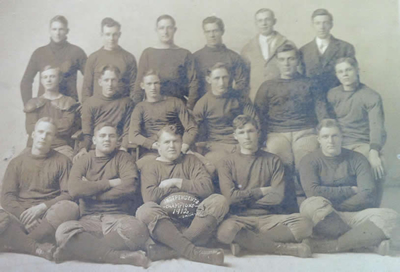
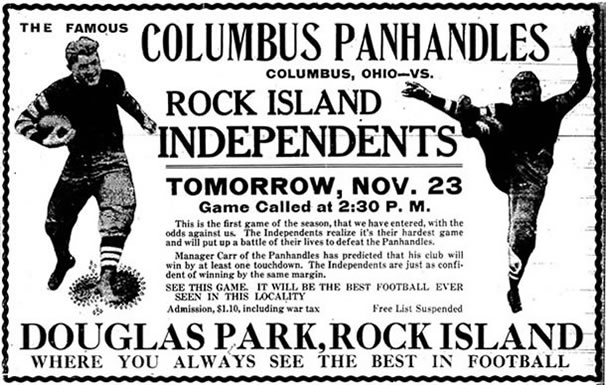
THE BEGINNING... The Rock Island Independents can be traced back to 1907. Teams back in those days were neighborhood teams, athletic club teams, social club teams and occasionally business owned teams. Players came together in the fall, had a couple practices and tried to schedule games with other local teams. The Independents were a neighborhood team based out of Rock Island Illinois. The team was not affiliated with any organizations or clubs thus the name the Independents. From the beginning, the Independents were a competitive team. In 1907 they finished with 2 wins, 1 loss and 3 ties. They outscored their opponents 82 to 12 for the season. 1908 they were undefeated. 1909 the team only organized for 3 games and was beaten badly in all three. 1910 and 1911 the team disappeared. In 1912 Jack Roche organized the team and took over as team manager. The Independents went 8-0 while outscoring their opponents 212-0. In 1913 Walter Flanigan became Assistant Manager under Jack Roche and remained in that position in 1914. In 1915 Flanigan took over the team and took on the responsibility of scheduling opponents. From 1912-1916 the team grew in popularity as did the popularity of football in America. The crowds had grown from a couple hundred in 1907 to as many as 6,000 by 1916. With no organization in football, it was common for teams to try to attract the best players, even if it meant collegiate and sometimes high school players. With the Independents popularity and reputation it is assumed they were able to get the best talent in the area. |
With this talent they were able to consistently handle most of the competition. Games with the rival Moline Indians and the Davenport Athletic Club were their toughest games. 1916 nobody initially stepped forward to organize the team. Old captain John Roche the long time Independents decided to form the team. Within days Walter Flanigan announced he had intended to organize the team. The battle went on into the season and players were not sure which manager to side with. There were challenges issued but the teams never played. Eventually several of Roche’s men deserted after he failed to secure a second game. Roche and Flanigan struck a deal and the Flanigan eleven were able to pick up the rights to the field Roche had secured for home games. The Independents struggled that year due to the confusion at the start of the season. The team split the series with the Moline Indians and against the Davenport AC they had one loss and a tie. For the first time in their history they could not claim to be the best team in the Tri Cities. Moline and Davenport both had good teams and after the confusion by all the teams at the start of the season, all 3 teams agreed that player jumping was bad for the game. On a positive note for the Independents, Moline and Davenport both had played well vs teams from outside the area in 1915 and 1916, this gave Flanigan credibility going into 1917.
|
TIME TO GROW... In 1917 Flanigan decided it was time to try to gain more recognition and possibly compete with some of the best known teams in the country. The team started out 6-0. Word of the team spread throughout the Midwest. Teams were sending game requests to Flanigan and many were denied. Flanigan wanted to schedule a team with a name people knew. Flanigan tried to schedule the famous Fort Wayne Friars, the game fell through. Across the river a nationally recognized team beat the rival Davenport AC 40-0, Flanigan invited them for a game in Rock Island. The Minneapolis Marines accepted the challenge and agreed to travel to Rock Island 2 weeks later. The Independents played a tough game and in the end the Marines were able to pull the game out 7 to 3. The following week they lost another tough game to the rival Davenport AC. After the loss to Davenport they once again hosted the Minnesota Marines, this time the Independents were beaten 33 to 14. The games against the Marines had significance though, several players from the Marines were impressed with what they saw in Rock Island and many of them joined the team in 1919. After 3 tough losses, the Independents were able finish on a strong note by beating Davenport easily. With a 7-3 record, the Independents were still a good team and the lessons they learned would help them in the future. In 1918 World War 1 put a damper on what was becoming professional football. The Independents kept it local and went 5-0 playing a relatively easy schedule.
|
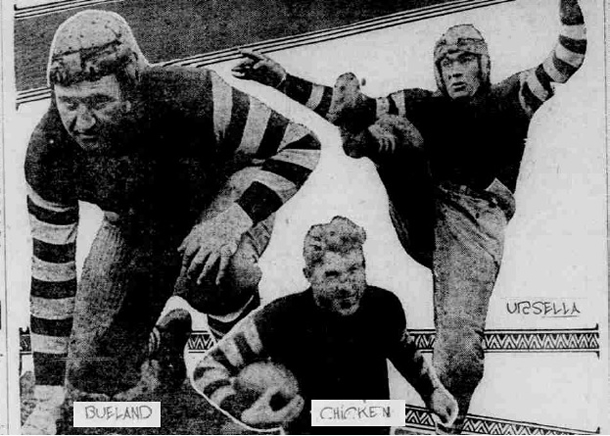
SHOT AT A CHAMPIONSHIP... In 1919 Walter Flanigan was able to lure the great quarterback, Rube Ursella away from the Minneapolis Marines. With Rube came several other players as well as their offense, the Minnesota Shift. It should be noted that Flanigan’s ability to build the Independents up near the level of teams like the Minneapolis Marines, the Fort Wayne Friars, Pine Village AC, and Taylorville with little national talent was an amazing feat upon itself. Flanigan's track record may have been a big factor in the decision of Ursella to come to Rock Island. No sources show Ursella playing college football anywhere and he must have bought into the ideas of owner Flanigan and saw it as a great opportunity. The Independents got off to an easy 2-0 start before facing the team from Hammond know as the Hammond $20,000 All Stars. There were many famous ex-collegiate stars on the team, including a George Halas. Unfortunately the Independents gave up a score late in the 4th quarter and lost 12 to 7. The Independents perfect season was over and so were their chances at the Professional Football Championship, or so they thought. The Independents went on to win 6 of their remaining 7 games and tying the Famous Pine Village AC. The Independents finished the season 9-1-1 while outscoring their opponents 309 to 12. The season was a huge success and by beating teams from Cincinnati, Columbus, and Akron the Independents did achieve their goal of gaining national recognition. | THE RIGHT HAS BEEN EARNED... For almost a decade, the teams in Ohio had their own loosely organized league. The Independent played 3 teams from Ohio that year and had soundly beaten all 3 of them. The truth is that the team from Canton Ohio run by Jim Thorpe and managed by Ralph Hay had talked with the Independents all season about scheduling a game. When the season was nearing the end, the Bulldogs were undefeated and the Independents had just 1 loss. The Independents felt they deserved a shot at Canton to settle the Championship. After all, the Independents had beaten many of the same teams and had scored nearly 100 more points. Canton showed interest in the game but must have decided better, they cancelled the game at the last minute and claimed the team had disbanded. Unfortunately, the history books recognize the Bulldogs as the 1919 champs, but there are some who think Rock Island should be considered. All in all it was a great year for the Independents and Ralph Hay and his Canton team took note. In 1920 when it came time to gather the best teams in the nation to form a professional football league, Flanigan and the Independents were invited… |
Professional Football Has Organization |
CANTON, OH Sept, 18, 1920 - "(Special) - The American Professional Football Association was formed here yesterday with the elections of Jim Thorp president, Stanley Cofall of Cleveland, vice president, and Arthur Rammey, secretary and treasurer. A committee was appointed to draw up a set of bylaws. Among the representatives were Dr. A Young of the Hammonds, Cofall of Cleveland, Walter Flanigan of Rock Island, Carl Stock of the Dayton Triangles and others". According to my friends at the Professional Football Research Association, on August 20th, several representatives of teams in the Ohio Professional League met to discuss an outline of basic organizational regulations. The ideas that came out of that first meeting were carried forward to the second meeting in Canton on September 17th. It was agreed that the purpose of the league would be to, “raise the standard of professional football in every way possible, to eliminate bidding for players between rival clubs and to secure cooperation in the formation of schedules, at least for the bigger teams." The meeting also addressed the matter of using intercollegiate stars in professional games on Sundays. The previous season, some startling disclosures of players using various phony names had angered several intercollegiate coaches resulting in the constant bashing of the pro game. The article went on to say, "no team will play an outside team that is not shown to be fair in its methods. There will be no more special "loading" for games. Lists of players will be forwarded in advance and the club must stick to the lineup". After that first meeting, the Ohio League owner's realized that unless the rest of the teams in the country agreed to those pledges and promises, then the they would soon find themselves victimized by the same practice they swore not to use. |
SECOND MEETING... There was no choice; Ralph Hay sent invitation to several teams throughout the country inviting them to the second meeting. Each club was asked to post $500, though some accounts say it was $100 and George Halas claimed no money ever exchanged hands. Teams present at the meeting were the Canton Bulldogs, Cleveland Tigers, Dayton Triangles, Akron Professionals, Rochester Jeffersons, Muncie Flyers, Hammond Professionals, Decatur Staleys A.C., Chicago Racine Cardinals, and the Rock Island Independents. It should be noted that several books mention the attendance of the Massillon Tigers, there was representation by Ralph Hay but once the meeting was started, he officially withdrew the team from the 1920 season. Four other teams, the Detroit Heralds, Chicago Tigers, Cleveland Tigers and Columbus Panhandles also played against several league opponents and are recognized by many sources as league teams in 1920. FROM THE ARTICLE... "Through yesterday's meeting, the teams are certain to give their publics much better football. The poorer teams will be placed in their class and will not be permitted to play the teams which are known to be too good for them. In this way, the one-sided hippodrome games will be eliminated. Experts in the game say that yesterday's step is one of the most far-reaching in the development of the game ever taken". Source The Daily Times - Davenport, IA September 18th 1920, By Frank Weir and the Professional Football Researchers Association. |
|